simpeg.electromagnetics.time_domain.Simulation3DMagneticFluxDensity#
- class simpeg.electromagnetics.time_domain.Simulation3DMagneticFluxDensity(mesh, survey=None, dt_threshold=1e-08, store_factors=False, **kwargs)[source]#
Bases:
BaseTDEMSimulation3D TDEM simulation in terms of the magnetic flux density.
This simulation solves for the magnetic flux density at each time-step. In this formulation, the electric fields are defined on mesh edges and the magnetic flux density is defined on mesh faces; i.e. it is an EB formulation. See the Notes section for a comprehensive description of the formulation.
- Parameters:
- mesh
discretize.base.BaseMesh The mesh.
- survey
time_domain.survey.Survey The time-domain EM survey.
- dt_threshold
float Threshold used when determining the unique time-step lengths.
- mesh
Attributes
Inverse of the factored system matrix for the DC resistivity problem.
Get cell inner product matrix.
Get inverse of cell inner product matrix.
Get cell center property inner product matrix.
Get cell center property inner product inverse matrix.
Get cell center property inner product matrix.
Get cell center property inner product inverse matrix.
Get cell center property inner product matrix.
Get cell center property inner product inverse matrix.
Get cell center property inner product matrix.
Get cell center property inner product inverse matrix.
Get edge inner product matrix.
Get inverse of edge inner product matrix.
Get edge property inner product matrix.
Get edge property inner product inverse matrix.
Get edge property inner product matrix.
Get edge property inner product inverse matrix.
Get edge property inner product matrix.
Get edge property inner product inverse matrix.
Get edge property inner product matrix.
Get edge property inner product inverse matrix.
Get face inner product matrix.
Get inverse of face inner product matrix.
Get face property inner product matrix.
Get face property inner product inverse matrix.
Get face property inner product matrix.
Get face property inner product inverse matrix.
Get face property inner product matrix.
Get face property inner product inverse matrix.
Get face property inner product matrix.
Get face property inner product inverse matrix.
Get node inner product matrix.
Get inverse of node inner product matrix.
Get node property inner product matrix.
Get node property inner product inverse matrix.
Get node property inner product matrix.
Get node property inner product inverse matrix.
Get node property inner product matrix.
Get node property inner product inverse matrix.
Get node property inner product matrix.
Get node property inner product inverse matrix.
Get volumes.
A list of solver objects to clean when the model is updated
SimPEG
Counterobject to store iterations and run-times.HasModel.deleteTheseOnModelUpdate has been deprecated.
Threshold used when determining the unique time-step lengths.
Mesh for the simulation.
The inversion model.
Magnetic permeability (h/m) physical property model.
Derivative of Magnetic Permeability (H/m) wrt the model.
Mapping of the inversion model to Magnetic Permeability (H/m).
Inverse magnetic permeability (m/h) physical property model.
Derivative of Inverse Magnetic Permeability (m/H) wrt the model.
Mapping of the inversion model to Inverse Magnetic Permeability (m/H).
Total number of time steps.
True if a model is necessary
Electrical resistivity (ohm m) physical property model.
Derivative of Electrical resistivity (Ohm m) wrt the model.
Mapping of the inversion model to Electrical resistivity (Ohm m).
Path to directory where sensitivity file is stored.
Electrical conductivity (s/m) physical property model.
Derivative of Electrical conductivity (S/m) wrt the model.
Mapping of the inversion model to Electrical conductivity (S/m).
Numerical solver used in the forward simulation.
Set solver-specific parameters.
Whether to store inner product matrices
Whether the factorization for each unique time step is stored.
The TDEM survey object.
Initial time, in seconds, for the time-dependent forward simulation.
Time mesh for easy interpolation to observation times.
Time step lengths, in seconds, for the time domain simulation.
Evaluation times.
Verbose progress printout.
Methods
Fields_DerivsJtvec(m, v[, f])Compute the adjoint sensitivity matrix times a vector.
Jtvec_approx(m, v[, f])Approximation of the Jacobian transpose times a vector for the model provided.
Jvec(m, v[, f])Compute the sensitivity matrix times a vector.
Jvec_approx(m, v[, f])Approximation of the Jacobian times a vector for the model provided.
MccMuDeriv(u[, v, adjoint])Get derivative of MccProperty with respect to the model.
MccMuIDeriv(u[, v, adjoint])Get derivative of MccPropertyI with respect to the model.
MccMuiDeriv(u[, v, adjoint])Get derivative of MccProperty with respect to the model.
MccMuiIDeriv(u[, v, adjoint])Get derivative of MccPropertyI with respect to the model.
MccRhoDeriv(u[, v, adjoint])Get derivative of MccProperty with respect to the model.
MccRhoIDeriv(u[, v, adjoint])Get derivative of MccPropertyI with respect to the model.
MccSigmaDeriv(u[, v, adjoint])Get derivative of MccProperty with respect to the model.
MccSigmaIDeriv(u[, v, adjoint])Get derivative of MccPropertyI with respect to the model.
MeMuDeriv(u[, v, adjoint])Get derivative of MeProperty with respect to the model.
MeMuIDeriv(u[, v, adjoint])Get derivative of MePropertyI with respect to the model.
MeMuiDeriv(u[, v, adjoint])Get derivative of MeProperty with respect to the model.
MeMuiIDeriv(u[, v, adjoint])Get derivative of MePropertyI with respect to the model.
MeRhoDeriv(u[, v, adjoint])Get derivative of MeProperty with respect to the model.
MeRhoIDeriv(u[, v, adjoint])Get derivative of MePropertyI with respect to the model.
MeSigmaDeriv(u[, v, adjoint])Get derivative of MeProperty with respect to the model.
MeSigmaIDeriv(u[, v, adjoint])Get derivative of MePropertyI with respect to the model.
MfMuDeriv(u[, v, adjoint])Get derivative of MfProperty with respect to the model.
MfMuIDeriv(u[, v, adjoint])Get derivative of MfPropertyI with respect to the model.
MfMuiDeriv(u[, v, adjoint])Get derivative of MfProperty with respect to the model.
MfMuiIDeriv(u[, v, adjoint])Get derivative of MfPropertyI with respect to the model.
MfRhoDeriv(u[, v, adjoint])Get derivative of MfProperty with respect to the model.
MfRhoIDeriv(u[, v, adjoint])Get derivative of MfPropertyI with respect to the model.
MfSigmaDeriv(u[, v, adjoint])Get derivative of MfProperty with respect to the model.
MfSigmaIDeriv(u[, v, adjoint])Get derivative of MfPropertyI with respect to the model.
MnMuDeriv(u[, v, adjoint])Get derivative of MnProperty with respect to the model.
MnMuIDeriv(u[, v, adjoint])Get derivative of MnPropertyI with respect to the model.
MnMuiDeriv(u[, v, adjoint])Get derivative of MnProperty with respect to the model.
MnMuiIDeriv(u[, v, adjoint])Get derivative of MnPropertyI with respect to the model.
MnRhoDeriv(u[, v, adjoint])Get derivative of MnProperty with respect to the model.
MnRhoIDeriv(u[, v, adjoint])Get derivative of MnPropertyI with respect to the model.
MnSigmaDeriv(u[, v, adjoint])Get derivative of MnProperty with respect to the model.
MnSigmaIDeriv(u[, v, adjoint])Get derivative of MnPropertyI with respect to the model.
dpred([m, f])Predicted data for the model provided.
fields(m)Compute and return the fields for the model provided.
fieldsPairgetAdiag(tInd)Return diagonal system matrix for the given time-step index.
getAdiagDeriv(tInd, u, v[, adjoint])Return derivative operation for the diagonal system matrix times a vector.
getAsubdiag(tInd)Return sub-diagonal system matrix for the time-step index provided.
getAsubdiagDeriv(tInd, u, v[, adjoint])Return derivative operation for the sub-diagonal system matrix times a vector.
Return the fields for all sources at the initial time.
getInitialFieldsDeriv(src, v[, adjoint, f])Return derivative of initial fields with respect to the model for a given source.
getRHS(tInd)Return right-hand sides for the given time index.
getRHSDeriv(tInd, src, v[, adjoint])Return right-hand side derivative times a vector for a given source and time index.
getSourceTerm(tInd)Return the discrete source terms for the time index provided.
make_synthetic_data(m[, relative_error, ...])Make synthetic data for the model and Gaussian noise provided.
residual(m, dobs[, f])The data residual.
Notes
Here, we start with the quasi-static approximation for Maxwell’s equations by neglecting electric displacement:
\[\begin{split}&\nabla \times \vec{e} + \frac{\partial \vec{b}}{\partial t} = - \frac{\partial \vec{s}_m}{\partial t} \\ &\nabla \times \vec{h} - \vec{j} = \vec{s}_e\end{split}\]where \(\vec{s}_e\) is an electric source term that defines a source current density, and \(\vec{s}_m\) magnetic source term that defines a source magnetic flux density. We define the constitutive relations for the electrical conductivity \(\sigma\) and magnetic permeability \(\mu\) as:
\[\begin{split}\vec{j} &= \sigma \vec{e} \\ \vec{h} &= \mu^{-1} \vec{b}\end{split}\]We then take the inner products of all previous expressions with a vector test function \(\vec{u}\). Through vector calculus identities and the divergence theorem, we obtain:
\[\begin{split}& \int_\Omega \vec{u} \cdot (\nabla \times \vec{e}) \, dv + \int_\Omega \vec{u} \cdot \frac{\partial \vec{b}}{\partial t} \, dv = - \int_\Omega \vec{u} \cdot \frac{\partial \vec{s}_m}{\partial t} \, dv \\ & \int_\Omega (\nabla \times \vec{u}) \cdot \vec{h} \, dv - \oint_{\partial \Omega} \vec{u} \cdot (\vec{h} \times \hat{n}) \, da - \int_\Omega \vec{u} \cdot \vec{j} \, dv = \int_\Omega \vec{u} \cdot \vec{s}_e \, dv \\ & \int_\Omega \vec{u} \cdot \vec{j} \, dv = \int_\Omega \vec{u} \cdot \sigma \vec{e} \, dv \\ & \int_\Omega \vec{u} \cdot \vec{h} \, dv = \int_\Omega \vec{u} \cdot \mu^{-1} \vec{b} \, dv\end{split}\]Assuming natural boundary conditions, the surface integral is zero.
The above expressions are discretized in space according to the finite volume method. The discrete electric fields \(\mathbf{e}\) are defined on mesh edges, and the discrete magnetic flux densities \(\mathbf{b}\) are defined on mesh faces. This implies \(\mathbf{j}\) must be defined on mesh edges and \(\mathbf{h}\) must be defined on mesh faces. Where \(\mathbf{u_e}\) and \(\mathbf{u_f}\) represent test functions discretized to edges and faces, respectively, we obtain the following set of discrete inner-products:
\[\begin{split}&\mathbf{u_f^T C e} + \mathbf{u_f^T } \, \frac{\partial \mathbf{b}}{\partial t} = - \mathbf{u_f^T } \, \frac{\partial \mathbf{s_m}}{\partial t} \\ &\mathbf{u_e^T C^T M_f h} - \mathbf{u_e^T M_e j} = \mathbf{u_e^T s_e} \\ &\mathbf{u_e^T M_e j} = \mathbf{u_e^T M_{e\sigma} e} \\ &\mathbf{u_f^T M_f h} = \mathbf{u_f^T M_{f \frac{1}{\mu}} b}\end{split}\]where
\(\mathbf{C}\) is the discrete curl operator
\(\mathbf{s_m}\) and \(\mathbf{s_e}\) are the integrated magnetic and electric source terms, respectively
\(\mathbf{M_e}\) is the edge inner-product matrix
\(\mathbf{M_f}\) is the face inner-product matrix
\(\mathbf{M_{e\sigma}}\) is the inner-product matrix for conductivities projected to edges
\(\mathbf{M_{f\frac{1}{\mu}}}\) is the inner-product matrix for inverse permeabilities projected to faces
By cancelling like-terms and combining the discrete expressions in terms of the magnetic flux density, we obtain:
\[\mathbf{C M_{e\sigma}^{-1} C^T M_{f\frac{1}{\mu}} b} + \frac{\partial \mathbf{b}}{\partial t} = \mathbf{C M_{e\sigma}^{-1}} \mathbf{s_e} - \frac{\partial \mathbf{s_m}}{\partial t}\]Finally, we discretize in time according to backward Euler. The discrete magnetic flux density on mesh faces at time \(t_k > t_0\) is obtained by solving the following at each time-step:
\[\mathbf{A}_k \mathbf{b}_k = \mathbf{q_k} - \mathbf{B}_k \mathbf{b}_{k-1}\]where \(\Delta t_k = t_k - t_{k-1}\) and
\[\begin{split}&\mathbf{A}_k = \mathbf{C M_{e\sigma}^{-1} C^T M_{f\frac{1}{\mu}}} + \frac{1}{\Delta t_k} \mathbf{I} \\ &\mathbf{B}_k = -\frac{1}{\Delta t_k} \mathbf{I}\\ &\mathbf{q}_k = \mathbf{C M_{e\sigma}^{-1}} \mathbf{s}_{\mathbf{e}, k} \; - \; \frac{1}{\Delta t_k} \big [ \mathbf{s}_{\mathbf{m}, k} - \mathbf{s}_{\mathbf{m}, k-1} \big ]\end{split}\]Although the following system is never explicitly formed, we can represent the solution at all time-steps as:
\[\begin{split}\begin{bmatrix} \mathbf{A_1} & & & & \\ \mathbf{B_2} & \mathbf{A_2} & & & \\ & & \ddots & & \\ & & & \mathbf{B_n} & \mathbf{A_n} \end{bmatrix} \begin{bmatrix} \mathbf{b_1} \\ \mathbf{b_2} \\ \vdots \\ \mathbf{b_n} \end{bmatrix} = \begin{bmatrix} \mathbf{q_1} \\ \mathbf{q_2} \\ \vdots \\ \mathbf{q_n} \end{bmatrix} - \begin{bmatrix} \mathbf{B_1 b_0} \\ \mathbf{0} \\ \vdots \\ \mathbf{0} \end{bmatrix}\end{split}\]where the magnetic flux densities at the initial time \(\mathbf{b_0}\) are computed analytically or numerically depending on whether the source carries non-zero current at the initial time.
Galleries and Tutorials using simpeg.electromagnetics.time_domain.Simulation3DMagneticFluxDensity#
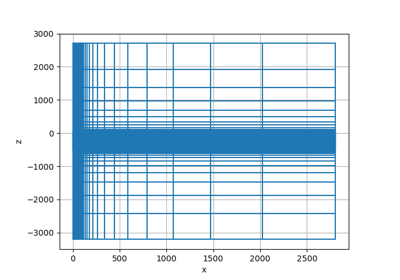
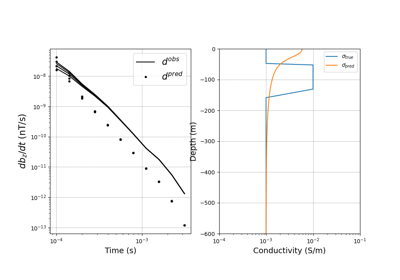
3D Forward Simulation for Transient Response on a Cylindrical Mesh